
We know God is in the business of working through his people to accomplish seemingly impossible tasks. One such man who embarked on what seemed to be an impossible task was, Nehemiah.
God needed him remember Jerusalem’s wall was still in ruins, and the news broke his heart. As he talked to God, a plan began to take form in Nehemiah’s mind about his own role in the rebuilding of the city walls. He willingly left the security of his home and job in Persia to follow God on an “impossible” mission. And the rest as they says is history.
From beginning to end, Nehemiah prayed for God’s help. He never hesitated to ask God to remember him, closing his autobiography with these words: “Remember me with favour, O my God.” Throughout the “impossible” task, Nehemiah displayed unusual leadership. The wall around Jerusalem was rebuilt in record time, despite resistance. Even Israel’s enemies grudgingly and fearfully admitted that God was with these builders. Not only that, but God worked through Nehemiah to bring about a spiritual awakening among the people of Judah.
You may not have Nehemiah’s unique abilities or feel that you are in a position where you can do anything great for God, but there are two ways you can become useful to God. First, be a person who talks to God. Welcome him into your thoughts and share yourself with him — your concerns, feelings, and dreams. Second, be a person who walks with God. Put what you learn from his Word into action. God may have an “impossible” mission that he wants to do through you.
Nehemiah’s strengths and accomplishments:A man of character, persistence, and prayer
Brilliant planner, organizer, and motivator
Under his leadership, the wall around Jerusalem was rebuilt in 52 days
As political leader, led the nation to religious reform and spiritual awakening
Was calm under opposition
Was capable of being bluntly honest with his people when they were sinning
Nehemiah demonstrated excellent leadership. He was spiritually ready to heed God’s call. He used careful planning, teamwork, problem solving, and courage to get the work done. Although he had tremendous faith, he never avoided the extra work necessary for good leadership. Being God’s leader is not just gaining recognition, holding a position, or being the boss. It requires planning, hard work, courage, and perseverance.
God is in the business of working through his people to accomplish seemingly impossible tasks. God often shapes people with personality characteristics, experiences, and training that prepare them for his purpose, and usually the people have no idea what God has in store for them. God prepared and positioned Nehemiah to accomplish one of the Bible’s “impossible” tasks.
Nehemiah’s Strengths and accomplishments:
A man of character, persistence, and prayer
Brilliant planner, organizer, and motivator
Under his leadership, the wall around Jerusalem was rebuilt in 52 days
As political leader, led the nation to religious reform and spiritual awakening
Was calm under opposition
Was capable of being bluntly honest with his people when they were sinning
Nehemiah & Leadership
Leaders have uncommon vision ~ A Leader sees …. (Nehemiah Ch2: 6-9 & Ch4)
Further. Nehemiah was able to see the problem even though he lived many miles from Jerusalem and he was creative in that he could visualise the solution.
More. Nehemiah knew the wall could & should be rebuilt and what it would take to do it. He obtained letters from the king to aid his passage and for materials.
Before. None of Jerusalem’s neighbours wanted the walls build, some conspired against him and the people. Nehemiah saw the danger and planned accordingly, refusing to give into enemy plots. He formulated strategies to defend the city & keep the people working.
Nehemiah knew his purpose, made his plans and led the people through the process bringing different groups together for one common task.
The 8 “he’s” of Nehemiah’s success, they were;
He identified with the problem
He spent time in prayer
He approached key influencers
He assessed the situation
He met with the people and cast the vision
He encouraged them with past success
He received buy-in from the people
He organised the people and got them working
So how did Nehemiah do it?
Well let’s look at a modern leadership theory developed by Professor John Adair.
Nehemiah and Action Centred Leadership
Professor John Adair developed action Centred Leadership; he is one of the world’s leading leadership experts. His theory on management development (Action Centred Leadership ~ ACL) is widely accepted as key to understanding leadership its role in managing the task, team & individuals.
Professor John Adair has written many books on leadership including ‘The Leadership of Jesus and its legacy today’. This book has influenced many Christian leaders today and he uses his foundational teaching on action centred leadership principles throughout the book.
Action Centered Leadership
As the name implies Action Centred Leadership (ACL) is a model used to highlight a way of leading and managing people, the team and the task.
John Adair’s Action Centred Leadership Model
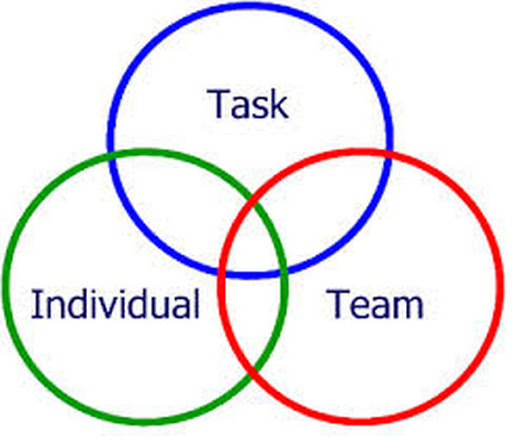
An effective leader will keep all three circles equal i.e. focus on all three areas equally
So what does it mean Task, Team & Individual?
Task: the vision or a specific task that needs to be completed
Team: who are the people needed to complete the task or fulfil the vision
Individual: who are the individuals, what are their strengths, what areas need developing, do they have the right A.S.K? Simply A.S.K. is something we have used whenever we consult, coach or train other and it asks us do our people have the right, Attitudes, Skills or Knowledge to complete a specific task of meet the vision or a specific takes.
Building upon Action Centred Leadership my theory is that the three circles can be taken to a further participation level. An effective leader will be able to communicate, poor communications are the root of all failure to successfully complete a task or vision. A competent leader allows effective participation for creative thinking and decision making and finally be able to influence positively the team.
Lets expand task, team and individual further and I will provide you with a template of the summary of actions that may help you in the future or help those you are developing.
Achieving the task:
The main contributions to achieving the task are:
Being quite clear what the vision, the aim of the church or the team is, putting it over with enthusiasm, and reminding people of it often
Understanding how the task fits in with the overall plans of the church, in both the short and long term
Planning how to accomplish the task
Determining and providing the required resources, time and levels of authority
Doing everything possible to ensure the church structure allows the task to be done efficiently
Pacing progress towards achievement of the task
Evaluating results and comparing them with the original plans and with the overall objectives of the church.
Building the team:
Most of our work is done in teams. A team is an entity in itself. Just as with people, no two teams are alike. To be a successful leader, you have to understand that your team, as a whole, has its own needs. At all times you must be responding to your team. The key actions of the leader in building the team are:Setting and maintaining the team’s objectives and standards
Involving the team as a whole in the achievement of objectives
Maintaining the unity of the team, and making sure disobedient activity is minimised
Communicating efficiently with the team by briefing them face-to-face at least once a month on matters which affect them at work
Consulting the team members before taking any decision which affects them
Developing individuals:
We must never forget that the members of our team are human beings. They have their own needs – to live and express themselves as individuals, to earn enough to provide for themselves and their families, to find satisfaction both at work and at play and to gain acceptance by their colleagues, if individuals are to be adequately motivated they:
Must be able to get satisfaction from personal achievement in what they are doing – this may differ from individual to individual
Must feel they are making a worthwhile contribution to the objectives of the team and the church
Must feel that what they are doing is challenging, is demanding the best of them and is giving them a degree of responsibility that matches their abilities
Must receive adequate recognition for their achievements
Must have genuine control over those aspects of the job that have been delegated to them (that is once you have delegated something, don’t interfere unless you really have to)
Must feel that they, as human beings, are developing and advancing in experience and ability.
Action Centred Leadership ~ summary of actions
| Key Actions | Task | Team | Individual |
| Define Objectives | Identify the task Constraints (parameters) | Involve the team to gain commitment | Clarify objectives |
| Consider options identify resources Set priorities, timescales and standards | Consult the team, encourage ideas Establish a structure | Assess individual skills, set objectives, allocate tasks, delegate and set targets | |
| Brief | Team briefings, clarify objectives outline the plan and provide information | Explain decisions invite feedback ask for questions, check understanding and motivating the team | Listen and enthuse individuals |
| Support | Check progress and maintain standards | Co-ordinate activities eliminate conflict and recognise effort | Advise, praise, reassure, provide coaching opportunities be consistent |
| Evaluate | Summarise, review objectives and re plan if required | Recognise and celebrate success, learn from mistakes and identify improvements and provide training | Appraise performance action plan for future development |
Copy the summary of actions and hand out to individuals as a reminder of what to do.

 Removing Barriers Releasing Potential